The HistoryÂ
The Ringstead Regatta is an old and revered tradition which recalls the years immediately after the Second Great War, when splendid sailing boats built of mahogany and oak assembled in Ringstead Bay for the purpose of a sailing race. In those early days, the winner was the boat to pass the finishing line first overall. In the early fifties, the entry of England’s National Firefly Champion, Richard Roscoe led to demands for a system of handicap which will be described later. The Regatta has been an annual event every year since its foundation. After the creation of the Ringstead Protection Society it has been usual to schedule it at 3 o’clock in the afternoon following the Annual General Meeting on the last Sunday of August. If the weather is inclement, it may be postponed, brought forward, or otherwise rescheduled as may be appropriate. There is no official record of past winners and participants – this is the cause of much argument and debate and must remain etched on the uncertain memories of those who watched from theshore or who took part at sea. The Trophy is an old and tarnished pewter cup blessed with fine and intricate decoration.Â
The PurposeÂ
The purpose is not so much as to win (so un-English) as to encourage all intrepid sailors of all ages and their craft (of all ages) into the water and to stage a spectacle which is a wonder to behold. It has been claimed that the privilege of organising the Regatta provides an unreasonable advantage to those who also take part. This is an uncharitable view to hold and is not supported by uncertain facts and statistics. The central purpose is to indulge in ribaldry and fun.
The Handicap and the RulesÂ
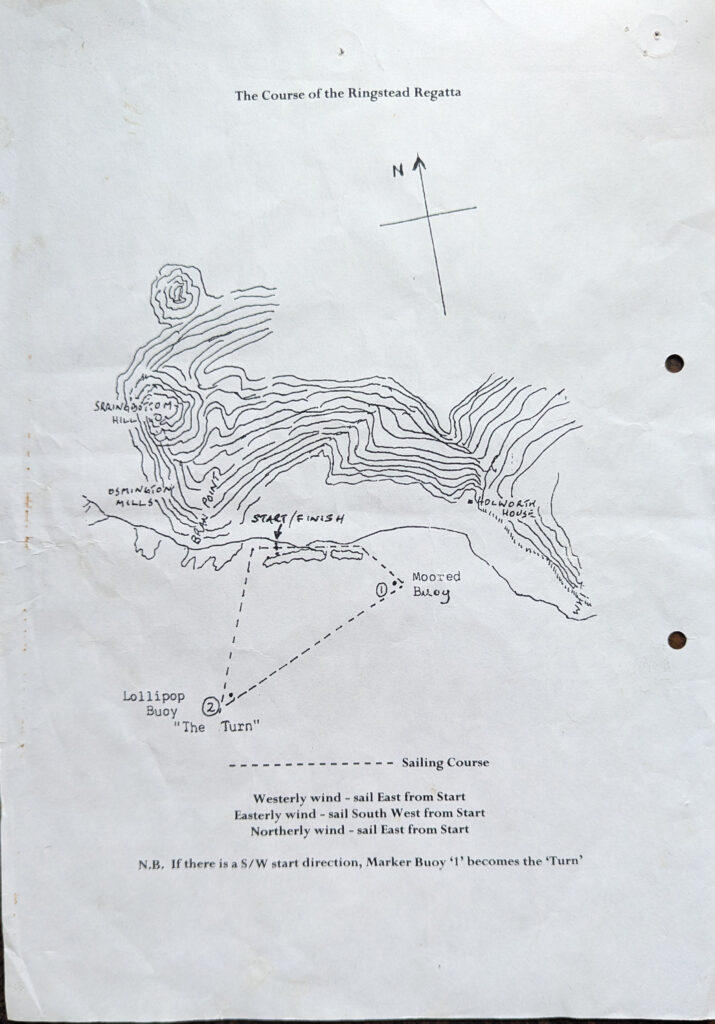
This is based on the oft quoted Biblical lore that “the first shall be last and the last shall be first”. The manner in which this is fulfilled is to establish the location of the marker buoy called the “Turn”. When the leading boat rounds this buoy, it is the moment to signal all the following boats, including the leading boat, to reverse direction and make their way back to the start/finishing line rounding all the buoys that they rounded earlier in the race. Thus in theory, there will be a great crush of boats both at the start and at the finish, creating the spectacle aforementioned. It is not sporting behaviour or permissible to dilly or to dally early in the race only to go like hell after the “Turn”. Boats that do not round the first marker buoy after the start do not qualify for the finish. Nevertheless, the crush at the start is such as to cause inadvertent conflict with other boats, the reefs and the shore – indeed delays caused by this phenomena have a curious way of being a common occurrence before the “Turn” but largely overlooked by the organisers. The Start of the Regatta is signalled by bells, guns, flags or other noticeable events an thebeach or cliff. Generally and variably. there is a five minute signal, followed by a one minute signal and afinal signal to commence racing. There is usually so much noise issuing forth from the boat of the self claimed winner that signals to mark this event are deemed not to be necessary. It should also be mentioned that disputes are quite normal and add to the general air of celebration.Â
The Resources for Safety and SupportÂ
Rescue boats of increasing speed and sophistication areusually in attendance to assist hapless participants. Life jackets and other life sustaining aids are a matter of personal choice and comfort. It is recommended that the younger crews take advantage of these aids to survival if only to keep the tradition of the Ringstead Regatta alive for future generations.
The Summary
The Ringstead community, west and east welcomes all entrants to the Regatta. They will be able to take advantage of valuable tips and profane advice from old sweats who know the form. Newcomers should not be discouraged by the news on entering the water that the Regatta has already started, that the course has suddenly been altered or lengthened or even that it has been postponed for the convenience of a participant who cannot cannot get his sail up after an alcoholic lunch. In such circumstances, they should launch their craft, await the pleasure of the organisers and eventually follow everyone else – and follow is the operative word.
Provenance: Anon c. 1979
E & OE